
Publish Date:
19 June 2026Keywords:
101% increase between 2018/19 and 2024/25
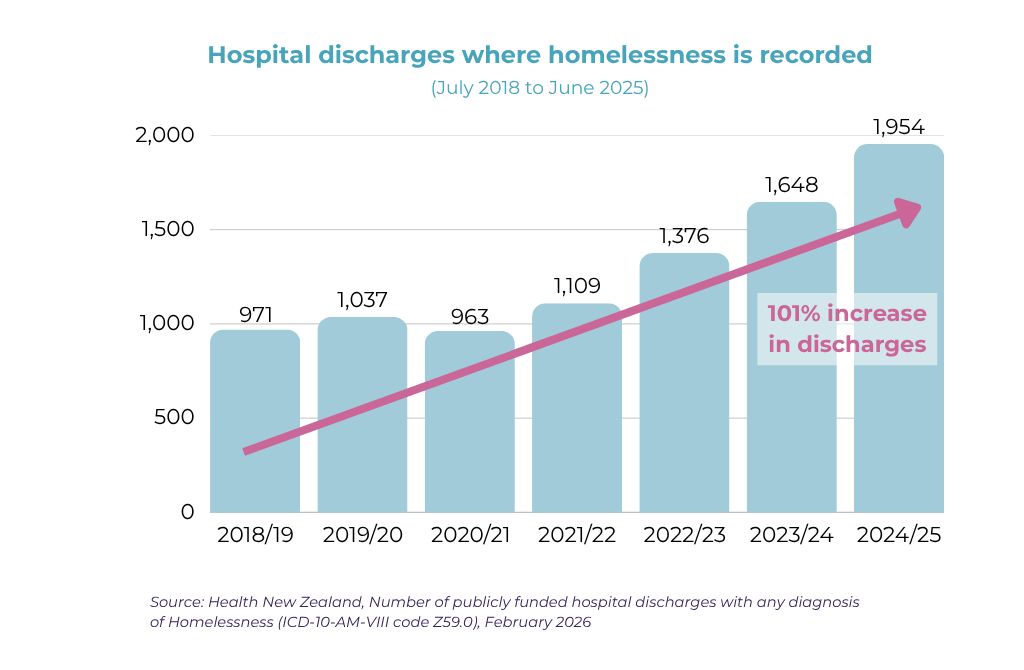 At a national level, there are gaps in the information gathered about people experiencing homelessness and their interactions with the health system. Each hospital is likely to hold detailed address information and potentially knows whether a patient is experiencing homelessness. However, specific address information is not reported to the National Collections team. There is an ICD code (Z59.0) which reflects that a person was homeless. This is only documented where someone being homeless was relevant to the hospitalisation. This means not everyone who is treated in a hospital and is homeless is captured in this data.
Males consistently account for around 65% of discharges (with any diagnosis of homelessness) across all years, with females at around 35%. Both groups are growing at similar rates, so the ratio is holding steady rather than converging.
Māori are disproportionately represented and growing fastest. Māori discharges rose from 414 in 2018/19 to 992 in 2024/25 — a 140% increase.
Auckland alone accounts for nearly 2,000 discharges — more than double the next-largest area (Bay of Plenty at 968). This reflects both population size and the concentration of homelessness in Auckland.
Hospital care is resource-intensive, and extended stays can place significant cost pressure on the health system. Investment in housing-led solutions for people experiencing homelessness will improve whānau wellbeing and reduce pressure on public systems.
Data source: OIA Health NZ, Publicly funded hospital discharges with any reported diagnosis code of homelessness, 2018/19-2024/25
