
Publish Date:
19 June 2026Keywords:
Stays reached a high point in 2019 before dropping in 2020 and 2021, most likely reflecting disruptions to service access during COVID-19
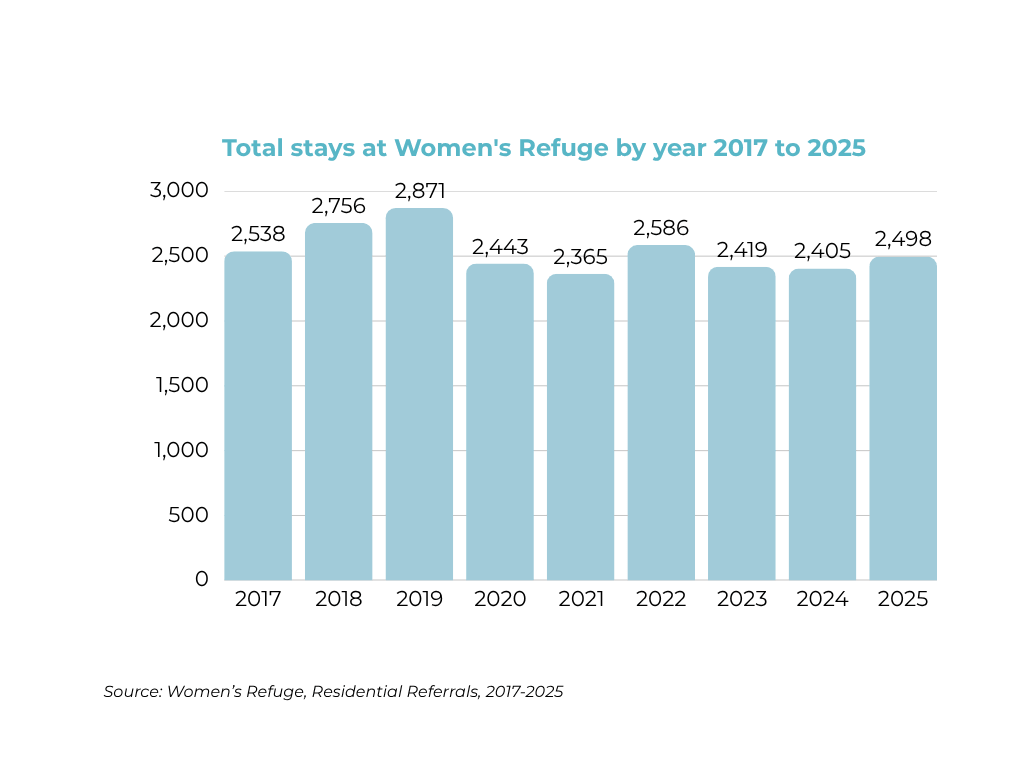
Women’s Refuge plays a critical role in supporting women and children experiencing housing instability. Women and children experiencing unsafe housing situations are often captured within homelessness data when they leave unstable or unsafe home environments.
Māori are heavily and increasingly overrepresented in Women’s Refuge figures. In 2017, Māori accounted for 42% of all stays. By 2025 that had risen to 55%, despite Māori making up roughly 17% of the New Zealand population. The absolute number of Māori stays has also grown — from 1,068 in 2017 to 1,379 in 2025 — even as the overall total has stayed flat.
Data Source: New Zealand Women’s Refuge, January 2026
